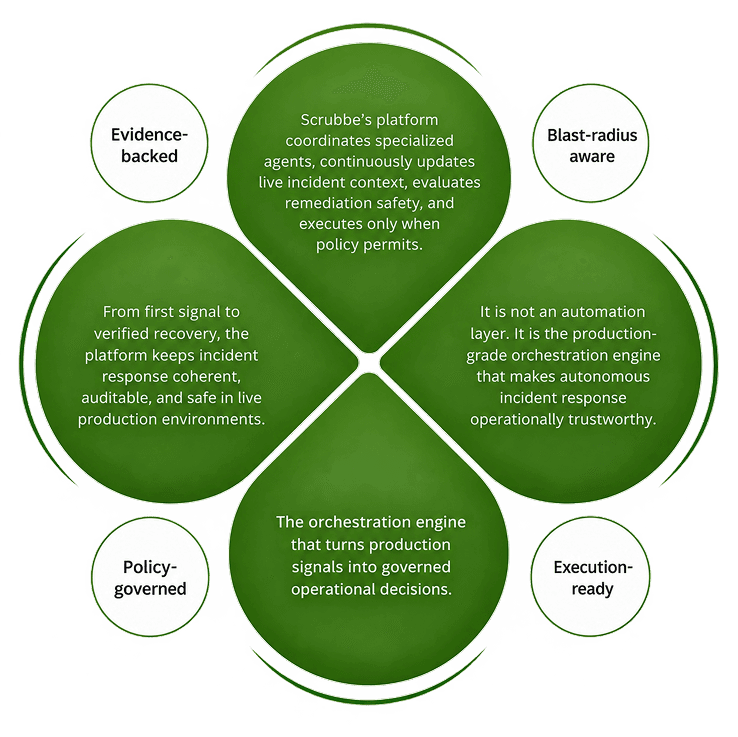
During an incident, Scrubbe continuously ingests changes across code, CI/CD pipelines, infrastructure, observability systems, service topology, and deployment state. It normalizes those signals into a single operational context, dispatches specialized agents in parallel, correlates evidence across domains, and drives the incident decision loop from first detection through verified recovery.
The platform is built for live production environments where correctness, auditability, and controlled execution matter as much as speed. Scrubbe does not optimize for the fastest possible action. It optimizes for the correct action, taken safely, with full traceability.
Agent
Responsibility boundary
Code analysis
Examines recent commits, pull requests, merges, and branch-level change history within the blast radius window of the current incident.
Deployment analysis
Evaluates deployment events, artifact versions, rollout timing, feature flag states, and CI/CD execution records across affected services.
Runtime investigation
Processes logs, distributed traces, metrics, saturation signals, and runtime anomalies correlated against the incident timeline and service topology.
Dependency tracing
Identifies upstream and downstream dependency failures, latency propagation paths, timeout cascades, and third-party service degradation patterns.
Remediation planning
Generates candidate remediation paths mapped to active hypotheses, ranked by evidence strength and operational appropriateness before simulation begins.
Impact verification
Monitors post-execution recovery signals, confirms service stabilization, and detects secondary degradation introduced by the remediation action itself.
Execution validation
Validates that approved actions were applied correctly, confirms execution state integrity, and records the full execution outcome for the audit trail.
The platform does not treat agent output as final truth. It continuously reconciles agent findings against live production evidence, historical context, service topology, policy constraints, and execution risk before advancing the decision process.