




Scrubbe Logo

Reduce waiting at approval gates.

Production incidents rarely wait for the right person to become available. When a critical service fails, engineering teams must quickly determine what happened, identify an appropriate response, and decide whether that response can be executed safely.

Book a demo

When the next action is already known

A considerable amount of incident response involves decisions that engineering teams have encountered before. A deployment introduces a regression and needs to be rolled back. A service becomes unhealthy and requires recovery. An infrastructure component reaches a known failure condition for which the organization has an established remediation procedure.

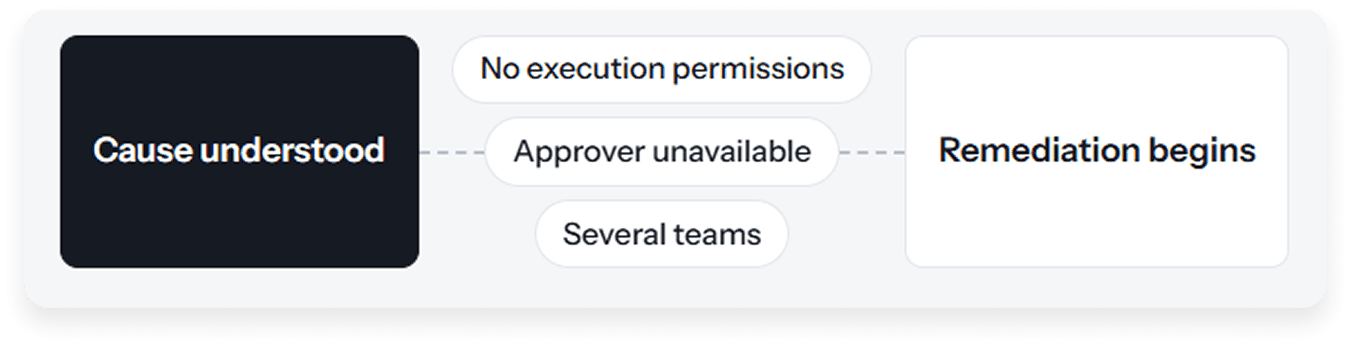
In each case, engineers may already understand the appropriate response. Yet the action can remain delayed because the person investigating the incident does not have execution permissions, an approver is unavailable, or the required authorization must pass through several teams.

During normal working hours, these delays may be manageable. Outside business hours, they can become more significant.

The cause is understood, but remediation waits on execution permissions, an available approver, or authorization across several teams.

The difference between control and delay

Production change controls are intended to protect systems from unauthorized, unsafe, or poorly understood actions. They establish who can make changes, under which circumstances, and with what level of oversight.

These safeguards are essential in environments where a single action can affect customer data, service availability, infrastructure security, or dependent systems. However, controls become less effective when they treat every action as though it carries the same level of risk.

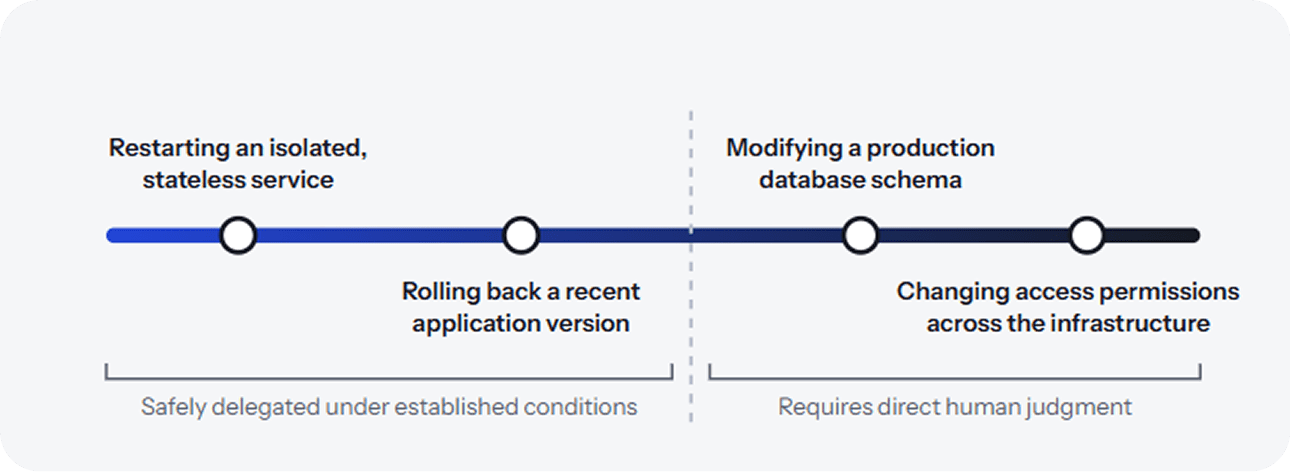
Restarting an isolated, stateless service under predefined conditions is not equivalent to modifying a production database schema. Rolling back a recently deployed application version is not the same as changing access permissions across an entire infrastructure environment.

Restarting an isolated, stateless service and rolling back a recent application version can be safely delegated under established conditions; modifying a production database schema or changing access permissions across the infrastructure requires direct human judgment.

Why manual approval processes become bottlenecks

Approval delays often reflect the way engineering authority is distributed across an organization. Application teams may own their services but depend on platform teams for infrastructure changes. SRE teams may coordinate incidents but require service owners to authorize specific actions. Security policies may restrict access to production environments, even when responders understand the remediation required.

These boundaries support accountability, but they also introduce dependencies between teams. During an incident, those dependencies can become more complicated. An engineer may need to explain the diagnosis to an approver who has not participated in the investigation. The approver may request additional evidence, ask about potential downstream effects, or seek confirmation from another team.


The person requesting authorization must explain what happened, why the proposed action is appropriate, what risks it introduces, and how recovery will be verified.

The person granting authorization must evaluate that information, often under considerable time pressure. When the evidence is incomplete or the responsibilities are unclear, the decision may be delayed further.

This creates a recurring operational problem: engineers spend valuable time transferring context and securing authority rather than executing an already established recovery procedure.

Faster decisions require better evidence

Reducing approval delays should not come at the expense of decision quality.

Reducing approval delays should not come at the expense of decision quality. A fast decision based on an incorrect diagnosis can make an incident worse. An action that appears safe in isolation may affect dependent services or introduce unintended consequences elsewhere in the environment.

The quality of an operational decision depends on the evidence available when that decision is made.
Before approving a rollback, for example, an engineer may need to establish whether the deployment is genuinely associated with the incident, whether the previous version is compatible with current infrastructure, and whether the rollback could affect other services.

Similarly, restarting a service may be appropriate when it has entered a known recoverable state, but less appropriate when the underlying failure involves persistent resource exhaustion or a dependency that remains unavailable.
Approval processes become more efficient when this context is available without requiring engineers to gather and explain it repeatedly.

Moving from manual permission to governed authority

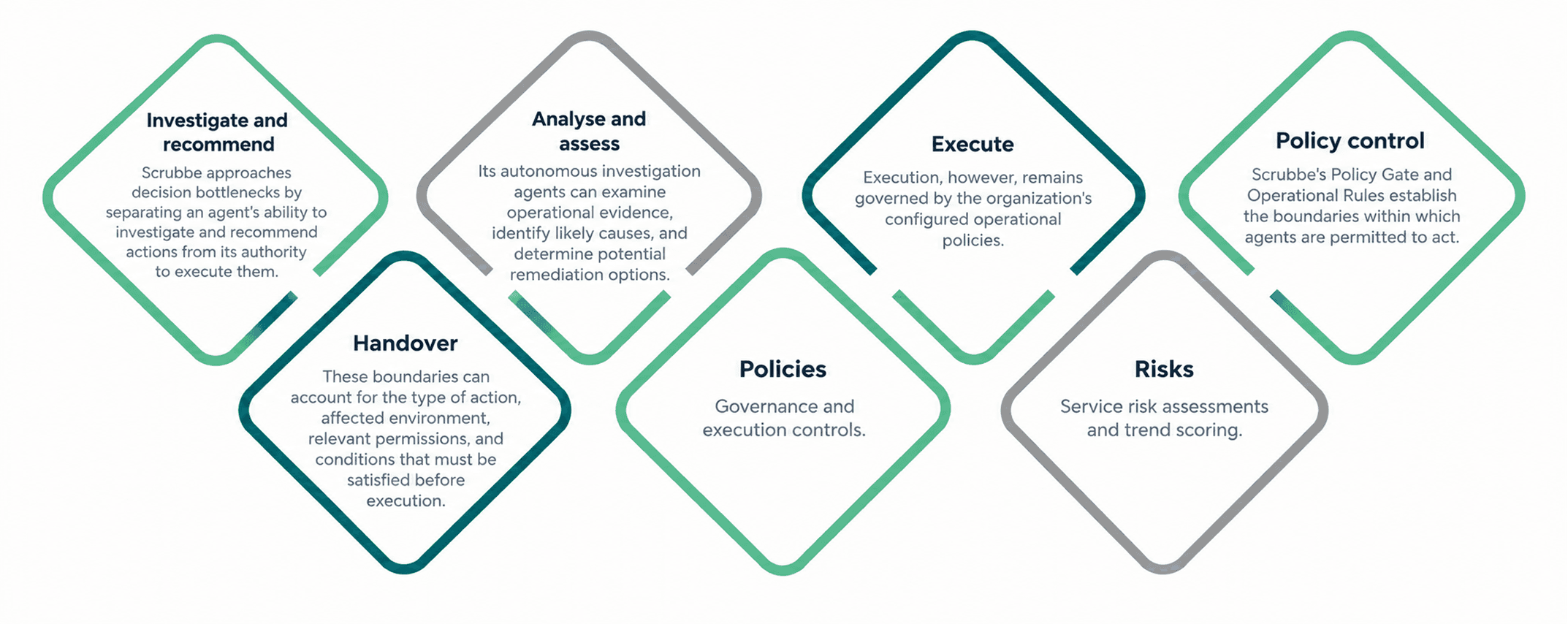
Scrubbe approaches decision bottlenecks by separating an agent's ability to investigate and recommend actions from its authority to execute them.

Investigate and recommend, handover, analyse and assess, policies, execute, risks and policy control — the stages between an agent's recommendation and a governed execution.

Governance should enable reliable operations

There is a common assumption that greater automation requires organizations to surrender control.

A fast decision based on an incorrect diagnosis can make an incident worse. An action that appears safe in isolation may affect dependent services or introduce unintended consequences elsewhere in the environment.

The quality of an operational decision depends on the evidence available when that decision is made. Before approving a rollback, for example, an engineer may need to establish whether the deployment is genuinely associated with the incident, whether the previous version is compatible with current infrastructure, and whether the rollback could affect other services.

Similarly, restarting a service may be appropriate when it has entered a known recoverable state, but less appropriate when the underlying failure involves persistent resource exhaustion or a dependency that remains unavailable. Approval processes become more efficient when this context is available without requiring engineers to gather and explain it repeatedly.

A well-supported remediation proposal should identify the observed failure, the evidence behind the diagnosis, the intended action, its expected impact, and the conditions under which it is permitted.

Remove unnecessary delays.
Keep control where it matters.

Let Scrubbe investigate production incidents, prepare evidence-backed remediation, and execute authorized actions within your operational policies.

Cookie preferences

We use essential cookies to keep Scrubbe secure and functional. You can choose whether to allow analytics, preferences, and marketing cookies, and update your choices at any time.

Essential cookies

Required for security, session continuity, consent state, and core site functionality. These are always on.

Always active

Analytics cookies

Help us understand usage patterns so we can improve product pages, onboarding paths, and documentation quality.

Allow analytics

Preference cookies

Remember selected settings such as region, UI preferences, and previously chosen site options.

Remember preferences

Marketing cookies

Enable campaign measurement and more relevant follow-up communications across trusted channels.

Allow marketing

Your choices are stored locally in this browser and can be updated at any time from the cookie settings button.